

At a glance
| What | Ibuki zairai soba: a native buckwheat from Mount Ibuki, GI-protected since 2019 |
| Where | Maibara City, Shiga, at the foot of Mount Ibuki |
| When | Flowers mid to late September; harvest late October, with new-season soba after that |
| Where to eat | Soba no Sato Ibuki, by the fields (closed Thursdays), or Tsurukian beside Hikone Castle (closed Wednesdays) |
| Cost | A soba lunch runs about ¥1,600–2,000 at Tsurukian |
| Getting there | 10 minutes by car from JR Omi-Nagaoka Station; Hikone is about 30 minutes away |
| Take home | Breath Farm’s dried Ibuki soba, 60% buckwheat |
| Pay with | Cash and a physical card, to be safe |
“They turn brown,” he said, pointing across the field. “And after they turn brown, we take them and make soba.”
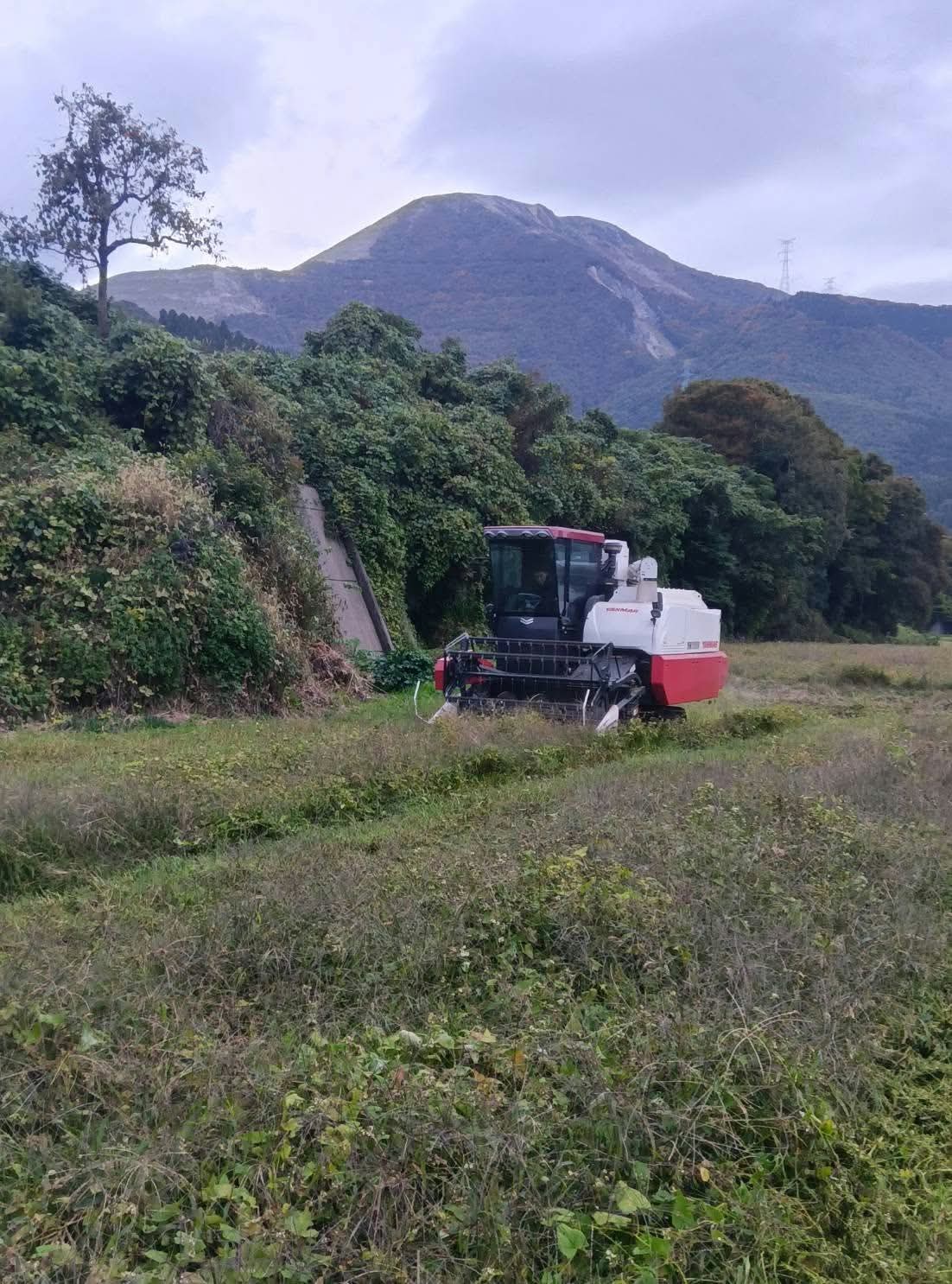
That was my introduction to Ibuki soba: standing at the edge of a buckwheat field at the foot of Mount Ibuki, in Maibara, Shiga, in October. Some fields were still a sea of white flowers. Others were already turning brown, with harvest days away.

My wife is from Gifu, just over the mountain from here. I’m retired now, and when I visit Japan, my hobby is finding Japan’s hidden gems. Travellers already go to Seki for its knives. I want to put food on that same map. So when I heard that this small corner of Shiga is where Japanese soba cultivation is said to have begun, I had to come and listen.
I met two directors of the Ibuki Zairai Soba Promotion Cooperative (伊吹在来そば振興協同組合): Ibuki Kunikazu and Ibuki Ryōichi. Yes, both are named Ibuki, which turns out to be a story in itself. Ryōichi’s restaurant, Soba no Sato Ibuki, sits beside the cooperative’s soba works and was closed that day, which is the only reason they had time to spend with us. Most of what follows is in Ryōichi’s words.
A small crop with a protected seed
Maibara grows about 50 hectares of Ibuki soba. Next to Hokkaido’s vast fields, that’s tiny. But they aren’t chasing volume. They’re chasing quality.
In 2019, Ibuki soba was registered under Japan’s Geographical Indication (GI) system, the same kind of protection Champagne or Parmigiano have. He showed me the official book of Japan’s GI products, with Ibuki soba listed inside. To carry the name, the soba must come from the native Ibuki seed. Nothing else counts.
And that seed is small. Under the GI rules, more than 70% of the grain must be 4.5 mm across or smaller. Commercial buckwheat runs bigger.
“The smaller the seed, the more aroma comes out,” he told me.
The catch is that small seeds are harder to process, so many millers don’t want them. In his words, it comes down to “economical versus quality”. Ibuki has chosen quality.
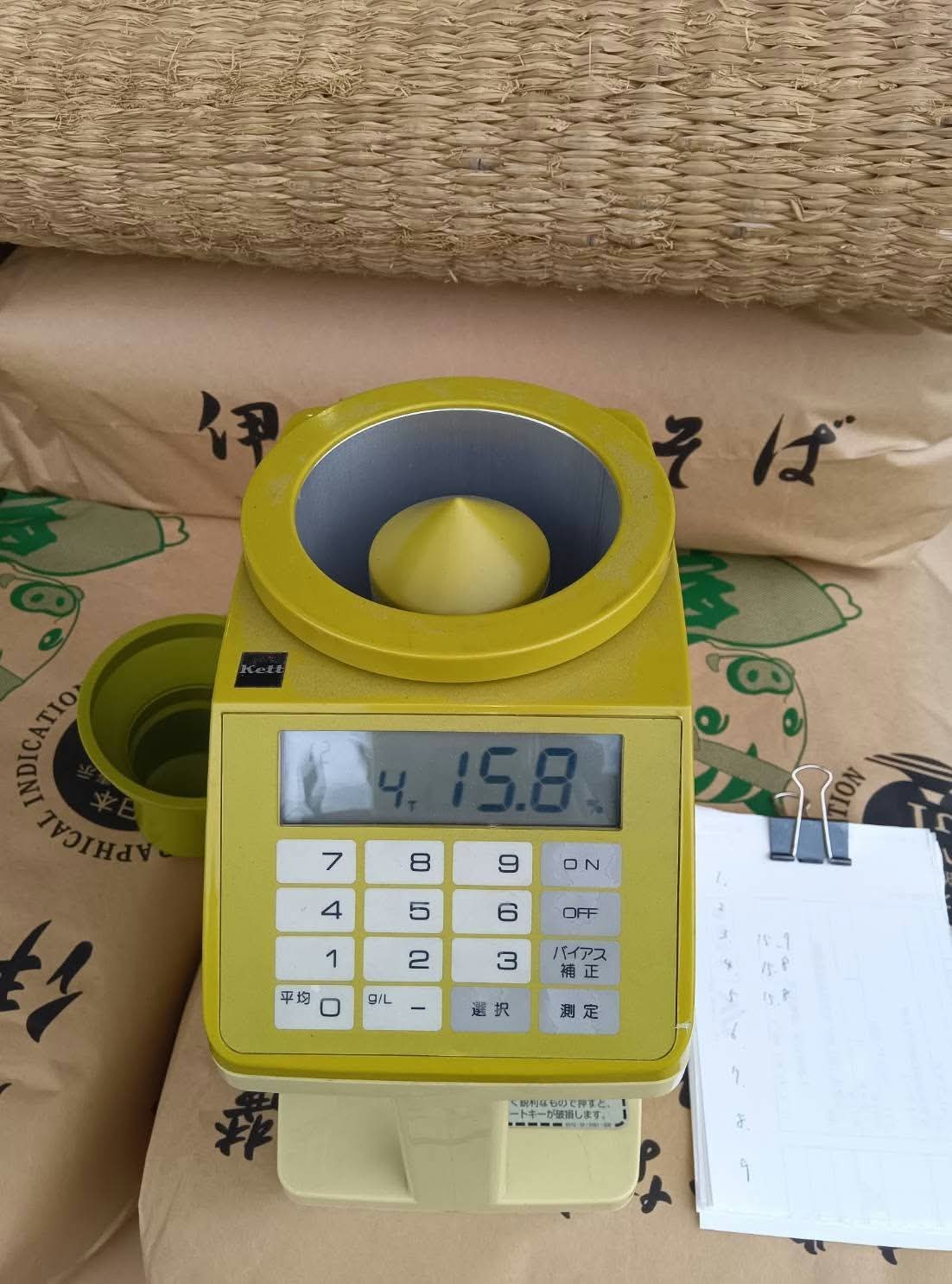
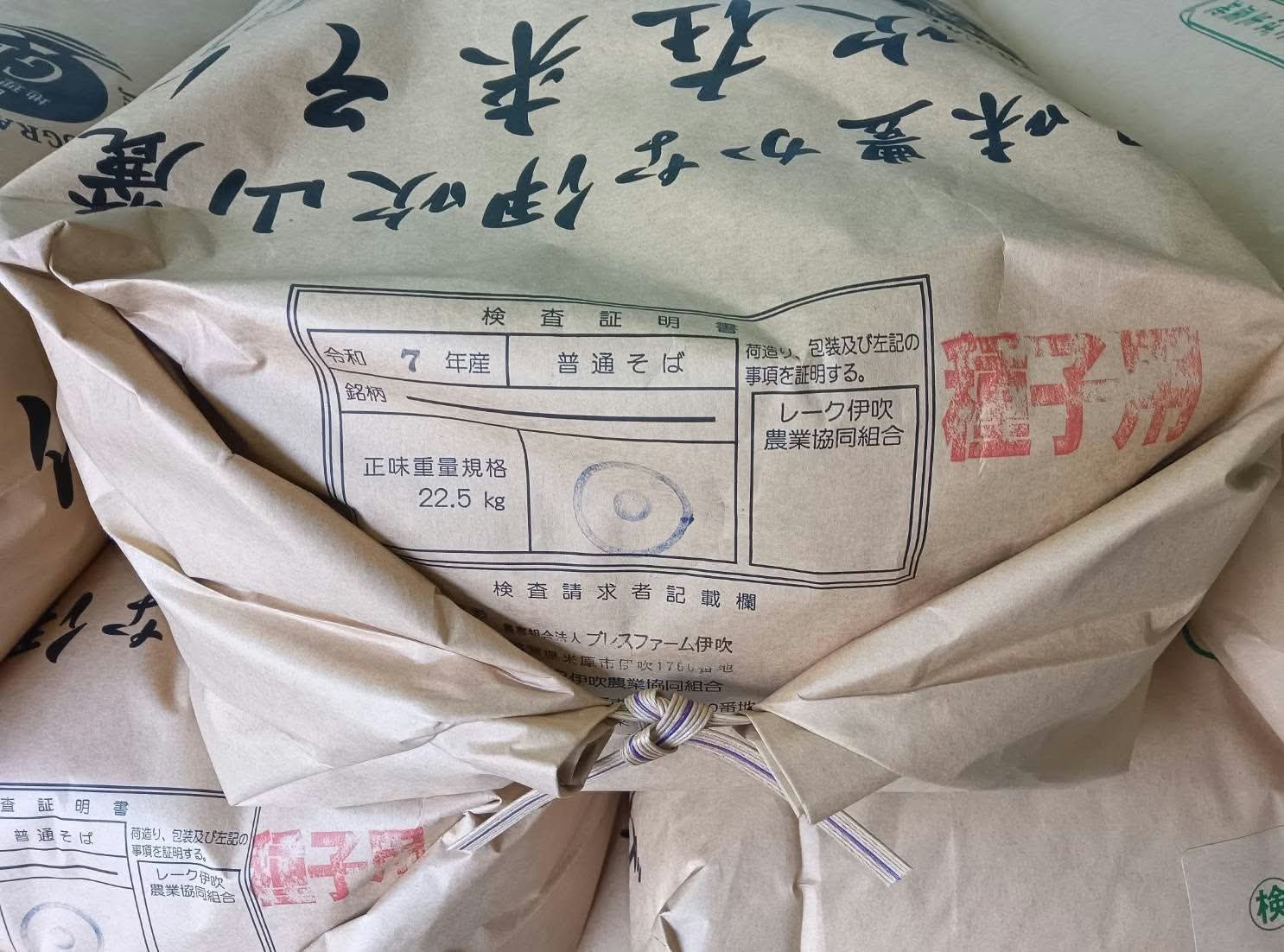
Every lot is checked before it leaves the farm. Ryōichi’s photos show the routine: the grain measured in a graduated cylinder, its moisture tested, then bagged and certified by the local agricultural cooperative. The bags below hold last year’s crop, stamped 種子用, “for seed”: next season’s planting.

The seed that nearly disappeared
Mount Ibuki has been a sacred mountain for centuries, home to ascetic monks and the temple of Ibukisan Gokokuji. According to the cooperative, buckwheat reached Japan from the north via the Korean peninsula around the 8th century, and its first fields in Japan were here, grown as food for those monks. Ryōichi showed me a copy of the Ibuki-yama Ezu, an early Edo-period map from the Ii family papers now held by the Hikone Castle Museum. Soba fields are marked on the mountain, alongside fields of Ibuki daikon, the fiery local radish.
But the native seed is hard work. It’s fussy about weather: too much rain or too much sun, and a farmer can harvest nothing at all. It also cross-pollinates easily, and once it mixes with another variety it’s no longer Ibuki seed. Over the 20th century, the growers dwindled.
By the time anyone tried to save it, he told me, only one farmhouse still held the seed. From the mid-1990s, Shiga Prefecture and local farmers began multiplying it again, and an association now exists to protect it.
This surprised me. I’d expected a family that had farmed soba for generations. It isn’t that. These are people who decided, fairly recently, that this seed was worth saving, and took on the job of keeping it alive.
Their business card says it best: よみがえる千年の香り、奇跡のそば. A thousand-year aroma, brought back. Miracle soba.

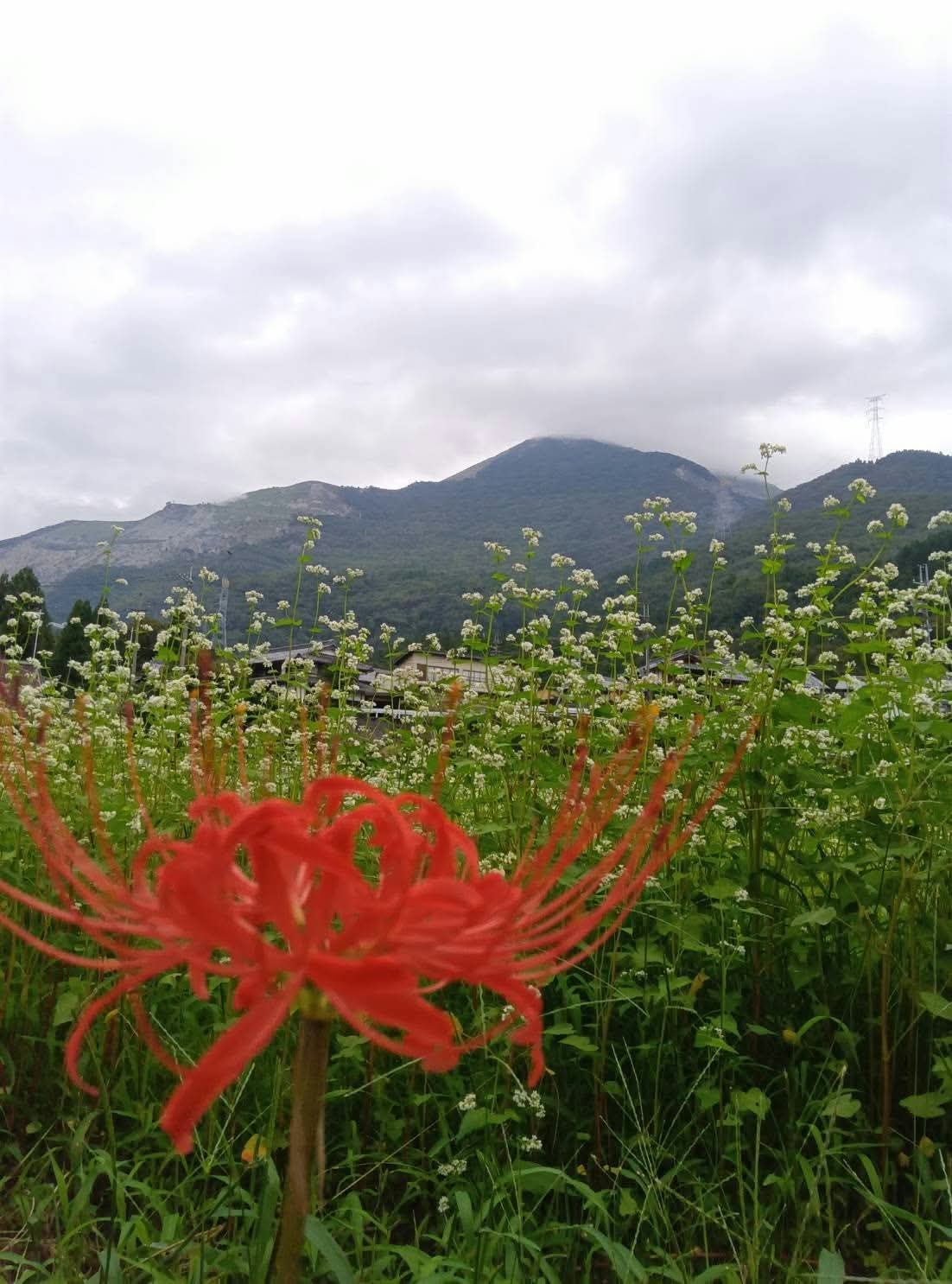
In September the white flowers share the field edges with red spider lilies, higanbana, which bloom around the autumn equinox.
It smells like chestnuts
I asked about the senses. Does the seed smell different from the flour?
The seed, it turns out, smells of almost nothing. The flour is where it starts. Ibuki soba flour smells like chestnuts, he said, though some people say fresh grass. Once it’s made into noodles the scent fades. Then you boil them, and it comes back.
The flour has a faint green tint, which is rare. Many growers dry their buckwheat fast to get it to market quickly, and it turns dark. Ibuki’s stays green because it’s handled fresh, and that green is where the umami and the aroma live.
The season matters too. Ibuki soba is planted twice a year, and the two crops taste different. Soba sown in spring is harvested in summer and has a lighter taste. Soba sown in late summer is harvested in autumn, and that’s the one with the chestnut aroma. I asked whether it was like wine grapes, where the timing of the pick changes everything. Much the same, he said: the later-season soba is the tastier one.
Hard water to drink, soft water for soba
Soba makers say water is half the recipe, and Ibuki’s water is a story in itself. Mount Ibuki is limestone, so the local water is hard, full of minerals.
He drinks the hard water, for the minerals. But for making soba he uses soft water. The town’s water system softens the supply so people can drink it comfortably.
I told him my hometown, Adelaide, has famously hard water, and it doesn’t taste great. It’s been softened too now. Two places a long way apart, solving the same problem.
100% buckwheat, from a man who started at retirement
Most soba in Japan isn’t pure buckwheat. It’s cut with wheat flour, which is cheaper and makes the dough far easier to handle. “But if you mix in flour, the soba smell is gone,” he said. Ryōichi’s restaurant serves 100% buckwheat soba, juwari, because he believes that’s how it should taste.
It’s rarer than you’d think. About 80% of the soba eaten in Japan is imported, he told me, with only around 20% grown at home. Buckwheat itself came from China, and in places like China and Ukraine it’s still mostly eaten as a porridge or grain. Cutting it into noodles was Japan’s idea, from the Edo period. In those days the Hikone domain presented Ibuki soba to the shogunate in Edo, and a verse of the time declared it famous throughout the land, its radish the finest too. Ryōichi was quick to add that other regions sent soba to Edo as well. Even now, soba is more Tokyo’s food. Kansai, where Shiga sits, is udon country, which makes this corner all the more unusual.
Ryōichi himself is 72. He didn’t open his restaurant until after he retired, in April 2020, just as COVID shut Japan down. Plenty of restaurants closed that year. His survived.
I told him he looks too young for 72. He credits soba. It’s rich in rutin, a nutrient few foods carry, and Shiga sits at or near the top of Japan’s longevity rankings. He encourages older people to eat soba regularly. Looking at him, I wasn’t going to argue.
From field to bowl in one place
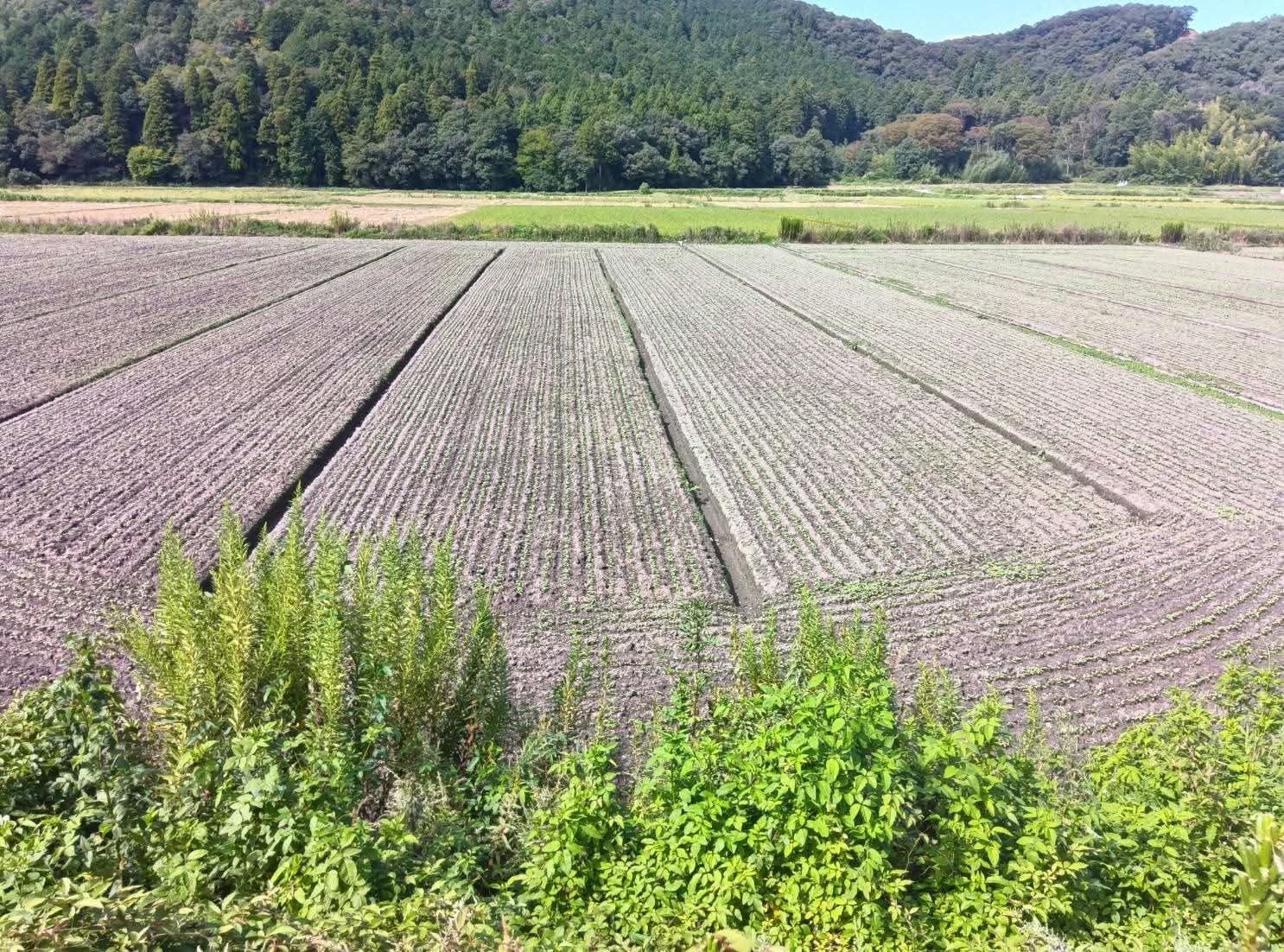
Soba is quick. Rice needs about 150 days in the ground. Buckwheat needs about 75. The autumn crop is sown in August, flowers white through September, and is harvested in October. The fields rotate through wheat, soba and rice, three crops every two years. The order matters: soba goes in straight after the wheat harvest, and rice follows the next year. In the Nagaoka area, sowing comes about a month later than elsewhere.
What makes this operation different is that they do everything themselves. They grow the soba, process it, make the noodles and serve them. A processing plant next to their restaurant means the whole chain stays at the foot of the mountain.
The revival is a community effort. Breath Farm Ibuki, the farming cooperative behind the soba works at 1760 Ibuki, joined with the hamlet farming groups around the mountain to expand planting. In 2013 they received the Ministry of Agriculture’s Production Bureau Director-General’s Prize at the National Soba Association’s awards for outstanding producers.
You can take some home, too. Breath Farm makes a dried soba from stone-milled whole Ibuki buckwheat, 60% buckwheat, which is unusually high for dried noodles because they’re so hard to make. One bag serves two: boil about 4½ minutes, then rinse quickly in cold water.
There are two groups behind it: one that produces the soba, and one that works to spread the word. Before COVID, soba associations across Japan drew crowds with events and free tastings. Those haven’t come back the same way, so getting the name out is slower now. That’s part of why I’m writing this.
They’ll also tell you buckwheat isn’t only for noodles. Roasted, it becomes soba tea. Cooked with rice, it gives the rice a soba aroma. And soba lovers will travel for it. “A bread lover will travel 100 kilometres for really good bread,” he said. “A soba lover will travel 200.” Visitors come from Kyoto and Osaka just to eat here. They have to, because the crop is too small to go far. Only around five restaurants serve Ibuki soba exclusively, and a few in Nagoya offer it for part of the year.
Where we ate it
With Ryōichi’s restaurant closed, the owners sent us to one they recommend: Tsurukian, right beside Hikone Castle and about 30 minutes from the fields. Its banner reads 献上伊吹そば, “kenjō Ibuki soba”: soba fit to present to the shogun. Read about our lunch at Tsurukian.

Before we left
As we were taking photos, someone mentioned a nice piece of trivia. Ibuki is also a surname, and a very rare one. By their count, only a very few people in Japan carry it, and two of them were standing in front of me. They aren’t related, and they don’t even write it the same way. Their business cards read 膽吹 and 伊富貴. Neither is the 伊吹 of the mountain.
If you love soba, Ibuki is worth the drive. Even if it’s 200 kilometres.
Harvest, inspection, sowing and spider lily photos courtesy of Ibuki Ryōichi.
How to visit
Ryōichi’s restaurant, Soba no Sato Ibuki, rotates its soba through the week: a darker whole-grain grind early in the week, a lighter hulled style from Friday, and 100% juwari on weekends only, in limited numbers.
| Name | Soba no Sato Ibuki (蕎麦の里 伊吹) |
| Type | Restaurant and producer |
| Prefecture | Shiga |
| Area | Ibuki, Maibara City |
| Address | 1749-2 Ibuki, Maibara, Shiga 521-0311 |
| Hours | Weekdays 11:00–14:00; weekends and holidays 11:00–15:00 |
| Closed | Thursdays |
| Reservation | Walk-in only |
| English | Japanese menu only |
| Payment | Cash only |
| Getting there | About 10 minutes by car from JR Omi-Nagaoka Station. Hikone Castle is about 30 minutes away |
| Best time | Mid-September for flowers; late October for harvest. Before harvest you’re eating last year’s crop |
| Price paid | Not eaten here: closed on our visit |
| Date visited | 15 October 2026 (fields and interview) |
For lunch on the same trip, Tsurukian in Hikone serves Ibuki soba beside the castle: opening days, prices and payment tips.
お店の方へ
膽吹邦一様、伊富貴良市様。先日はお忙しい中、貴重なお話をありがとうございました。この記事では、伊吹在来そばの歴史、小さな在来種を守る取り組み、栗のような香り、そして十割そばへのこだわりを、オーストラリアや海外の読者に向けて英語で紹介しています。畑、花、種、収穫、お食事の写真も掲載させていただきます。内容に修正が必要な点があれば、ご遠慮なくお知らせください。JapanFoodStyle デーブ・スタントン


